How to Create a Monthly Budget That Actually Works in Namibia
Posted on 15th August 2026 | Financial Tips
Learn how to create a practical monthly budget in Namibia, manage your income, control spending, prepare for emergencies and improve your financial stability.
How to Create a Monthly Budget That Actually Works in Namibia
Managing money can sometimes feel like trying to make a small amount stretch across a very long list of expenses.
Your salary comes in, bills need to be paid, groceries have to be bought, transport costs money, children have needs, unexpected expenses appear—and somehow you’re expected to save something at the end of the month.
If you’ve ever reached the middle or end of the month and wondered, “Where did all my money go?”, you’re not alone.
The solution isn’t necessarily earning more money. While increasing your income can certainly help, one of the most powerful things you can do is develop a clear understanding of where your money is going.
That’s where a monthly budget comes in.
A good budget isn’t designed to make your life miserable or prevent you from enjoying your money. Instead, it gives every part of your income a purpose so that you can make financial decisions with greater confidence.
In this guide, we’ll look at how to create a monthly budget in Namibia that is realistic, flexible and actually usable in everyday life.
What Is a Monthly Budget?
A monthly budget is a simple plan that shows:
- How much money you expect to receive
- What you need to spend
- What you want to spend
- What you need to save
- What financial commitments you need to meet
The purpose is not to predict every expense perfectly.
Instead, your budget gives you a financial roadmap for the month.
Think of it as telling your money where to go before it disappears.
Why Is Budgeting Important?
Without a budget, it’s easy to underestimate how much you spend on small purchases.
A takeaway here.
Fuel there.
A few items from the shop.
An unexpected subscription.
Money sent to a family member.
A quick purchase that seemed insignificant at the time.
Individually, these expenses may not seem like much. Together, however, they can make a significant difference to your finances.
A budget helps you see the bigger picture.
It can help you:
- Control unnecessary spending
- Prepare for upcoming expenses
- Identify financial leaks
- Save more consistently
- Reduce financial stress
- Prepare for emergencies
- Make better borrowing decisions
Step 1: Calculate Your Total Monthly Income
Start with the money you actually expect to receive during the month.
For someone employed, this may primarily be their salary.
For someone self-employed or running a business, income may fluctuate from month to month.
Your income could include:
- Salary
- Business income
- Freelance income
- Commission
- Regular side income
- Other reliable income sources
If your income changes from month to month, avoid creating a budget based on your best-case month.
Instead, use a conservative estimate.
This prevents you from committing to expenses that may become difficult to maintain when your income is lower.
Step 2: List Your Fixed Expenses
Fixed expenses are costs that generally remain the same or relatively predictable each month.
Examples may include:
- Rent or bond payment
- School fees
- Insurance
- Loan repayments
- Internet
- Certain subscriptions
- Other contractual commitments
Write them down.
Don’t rely on memory.
Seeing the numbers in front of you gives you a much clearer picture of your financial obligations.
Step 3: List Your Variable Expenses
Variable expenses change from month to month.
These might include:
- Groceries
- Fuel
- Electricity
- Water
- Clothing
- Entertainment
- Eating out
- Household purchases
These expenses can be more difficult to control because they aren’t always exactly the same.
That’s why tracking them is so important.
Step 4: Separate Needs From Wants
This is one of the most important parts of creating a useful budget.
Ask yourself:
Do I need this, or do I simply want it?
Needs may include:
- Food
- Housing
- Electricity
- Water
- Transport
- Healthcare
- Essential school expenses
Wants may include:
- Entertainment
- Eating out
- New gadgets
- Unnecessary shopping
- Luxury purchases
This doesn’t mean you should eliminate every want.
You simply need to make sure your wants don’t consume money that should be allocated to essential expenses and financial goals.
Step 5: Give Your Money a Job
Once you’ve identified your income and expenses, assign your available money to specific categories.
For example:
Income
N$15,000
Essential expenses
N$8,000
Transport and groceries
N$2,500
Savings
N$1,500
Debt/financial commitments
N$1,500
Flexible spending
N$1,000
The exact numbers will obviously differ from household to household.
The important principle is this:
Your budget should reflect your actual life—not an imaginary perfect financial situation.
Step 6: Create an Emergency Fund
One of the biggest weaknesses in many household budgets is the absence of money set aside for unexpected expenses.
A vehicle breaks down.
A medical expense appears.
An appliance stops working.
A family emergency occurs.
Suddenly, money that was intended for groceries or other bills has to be redirected.
An emergency fund provides a financial buffer.
You don’t have to start with a huge amount.
Even putting aside N$100, N$200 or N$500 consistently can gradually build a safety net.
The important thing is consistency.
For more practical advice about handling unexpected costs, read our guide:
“How to Handle Emergency Expenses Without Financial Stress in Namibia.”
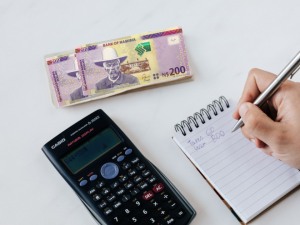
Step 7: Track Your Spending
Creating a budget is only half the job.
You also need to know whether you’re actually following it.
For one month, write down everything you spend.
You can use:
- A notebook
- A spreadsheet
- A budgeting app
- Your banking app
- A simple notes application on your phone
Don’t only track large purchases.
Track the small ones too.
You may discover that several seemingly insignificant purchases are consuming a surprising amount of your income.
Step 8: Identify Your Financial Leaks
A financial leak is an expense that repeatedly takes money from your budget without providing enough value.
Examples might include:
- Unused subscriptions
- Frequent takeaway meals
- Impulse shopping
- Excessive entertainment spending
- Unnecessary bank charges
- Purchases you make out of habit
You don’t need to eliminate everything enjoyable.
Instead, identify the expenses that aren’t contributing much to your life and redirect some of that money toward more important priorities.
Step 9: Budget for Irregular Expenses
Some expenses don’t happen every month—but that doesn’t mean you should ignore them.
Think about:
- School-related costs
- Annual insurance payments
- Vehicle maintenance
- Birthdays
- December expenses
- Holidays
- Household maintenance
If you know an expense is coming, start preparing for it early.
For example, if you expect a N$2,400 expense in six months, saving N$400 per month means you’re much less likely to experience financial pressure when the bill arrives.
Step 10: Create a Payday Routine
One of the easiest ways to improve your budgeting discipline is to create a routine around payday.
When your income arrives:
First:
Cover your essential commitments.
Second:
Set aside savings or emergency funds.
Third:
Allocate money for groceries, transport and other necessities.
Finally:
Allocate your discretionary spending.
This approach reduces the temptation to spend freely at the beginning of the month and worry about bills later.
Step 11: Don't Forget Existing Financial Commitments
If you already have financial commitments, they need to be included in your budget.
For example:
- Existing loan repayments
- Credit obligations
- Insurance
- School commitments
- Other recurring payments
Ignoring these expenses can make your budget appear healthier than it actually is.
Your budget should show the real financial picture.
If you’re considering borrowing money, understanding affordability is particularly important. Our article “How Do Cash Loans Work In Namibia (A Beginner’s Guide)” gives some information on how lenders work in Namibia.
Step 12: Give Yourself Some Flexibility
A budget shouldn’t be so strict that one unexpected expense destroys the entire plan.
Life happens.
Your child may need something unexpectedly.
Your car may need a repair.
Your electricity bill may be higher than expected.
That’s why it’s useful to leave some room in your budget for unexpected or flexible expenses.
A realistic budget is much easier to maintain than an unrealistic one.
Should You Use a Loan to Cover a Budget Shortfall?
A loan shouldn’t automatically be the first solution whenever your budget falls short.
First, understand why you’re short.
If your expenses consistently exceed your income, taking another loan may simply postpone the underlying problem.
However, genuine emergencies can happen even when you have a carefully planned budget.
An unexpected medical expense, essential vehicle repair or family emergency may require financial assistance that wasn’t included in your normal monthly spending.
In such circumstances, it’s important to assess the situation carefully, consider your alternatives and understand whether any borrowing would be affordable to repay.
Our article “Top Reasons People Apply for Short-Term Loans in Namibia (And When It Makes Sense)” discusses situations where short-term borrowing may be appropriate and when it may be better to consider alternatives.
What If You Run Out of Money Before Payday?
This is one of the clearest signs that your budget needs to be reviewed.
Before immediately looking for additional money, ask:
- Where did my money go?
- Which expenses were unexpected?
- Which expenses could have been reduced?
- Did I underestimate groceries or transport?
- Did I spend too much on non-essential items?
If this happens regularly, our guide “What to Do When You Run Out of Money Before Payday in Namibia” provides additional strategies for managing that situation.
How to Make Your Budget Easier to Maintain
The best budget isn’t necessarily the most complicated one.
Keep it simple.
You could start with just five categories:
1. Housing
Rent, bond and related costs.
2. Essentials
Food, electricity, water and other necessities.
3. Transport
Fuel, public transport and vehicle-related costs.
4. Financial Goals
Savings, emergency fund and debt reduction.
5. Lifestyle
Entertainment, eating out and other discretionary spending.
Once you become comfortable with this system, you can create more detailed categories.
Review Your Budget Every Month
Your budget shouldn’t be a document you create once and forget about.
At the end of each month, ask:
What worked?
What didn’t work?
Where did I overspend?
What unexpected expenses appeared?
What can I change next month?
Your budget should evolve with your life.
The Goal Isn't Perfection
Perhaps the most important thing to remember is that budgeting isn’t about getting everything right every month.
You will make mistakes.
You will overspend occasionally.
Unexpected expenses will happen.
That’s okay.
The goal is to become increasingly aware of your financial decisions and gradually improve your habits.
A budget gives you a system for doing exactly that.
How Silverline Financial Solutions Can Help
At Silverline Financial Solutions, we believe financial assistance should be accompanied by responsible financial decision-making.
That’s why financial education matters.
Understanding your income, expenses and repayment commitments can help you make better decisions when considering financial products.
If you ever find yourself facing an unexpected financial need, take the time to understand your options and make sure any financial commitment fits within your ability to repay.
Final Thoughts
A monthly budget doesn’t have to be complicated.
It simply needs to give you a clear picture of what comes in, what goes out and what you’re trying to accomplish with your money.
Start small.
Write everything down.
Track your spending.
Build an emergency fund.
Review your progress every month.
Most importantly, don’t become discouraged if your first budget doesn’t work perfectly. Adjust it and try again.
The goal isn’t to control every cent of your life. The goal is to make your money work more intentionally for you.
✅ Ready for Financial Assistance?
Sometimes, even the best budget can’t prevent an unexpected emergency.
If you’ve reviewed your options and need financial assistance for an essential expense, you can complete our online loan application to begin the process.
If you have questions before applying, contact our team today and we’ll be happy to assist you.
Here are some Frequently Asked Questions
1. What is the easiest way to start a monthly budget?
Start by writing down your total monthly income and all your regular expenses. Then separate essential expenses from non-essential spending and assign your available money to each category.
2. How much should I save every month?
There isn’t one amount that works for everyone. Start with an amount that is realistic for your income and expenses—even a small consistent contribution can help build the habit of saving.
3. What should I do if my expenses are higher than my income?
Review your spending, identify expenses that can be reduced or eliminated, and look for ways to increase income if possible. Avoid relying on borrowing to repeatedly cover a structural monthly shortfall.
4. Should emergency savings be included in my budget?
Yes. Treat emergency savings as a planned financial priority rather than something you only do when you have money left over.
5. Can budgeting help me avoid unnecessary loans?
Yes. A well-managed budget can help you anticipate expenses, build savings and identify financial problems earlier, potentially reducing the need to borrow for smaller unexpected costs.